Incompleteness, Mariane Ibrahim’s latest exhibition in Paris, proposes a structure of attention that privileges partiality, vulnerability, and the refusal of closure across three distinct practices. The exhibition brings together Shannon T. Lewis, Cristina Flores Pescorán, and Naomi Lulendo, artists whose lives and work unfold across multiple geographies, each shaped by forms of circulation and negotiation that resist singular belonging.
Shannon T. Lewis (b. 1981, Toronto; lives in Berlin) constructs pictorial thresholds in which interior and exterior collapse into one another. The Key to Where We Really Live (2026) opens the exhibition with an installation in which three paintings coalesce into a composite body through their dialogue with an arched form painted directly onto the wall. Multiple perspectives coexist, disorienting the viewer and resisting a singular point of view. In nearby paintings such as Before the Light Changed (2025) and Altars Beyond Recognition (2025), the body is displaced and reconstituted through gesture: hands emerge, withdraw, or linger at the threshold of objects and spaces. Across these works, the figure is never fully present but persists through fragments.
Cristina Flores Pescorán (b. 1986, Lima; lives in Utrecht) approaches the body as a site of rupture and repair, where textile and sculptural forms, rooted in ritual and material knowledge, reimagine healing beyond the limits of the clinical.
In the main gallery, Siete Momentos para Sanar un Susto (Seven Steps to Overcoming a Spook, 2024) presents an installation composed of seven textile sculptures extending from the wall, held in place by long needles. Emerging from the artist’s experience of illness and recovery, the work transforms the clinical gesture of the biopsy into a ritualized act in which the body is both fragmented and reassembled. Working with undyed Peruvian cotton, purple corn, and copper thread, Flores Pescorán draws from pre-Columbian textile traditions to produce forms that evoke suturing, protection, and care. In the drawings Juegos en mi Chacra (Games in my Chacra, 2024), the body appears dispersed, subtly embedded within the woven structures that sustain it.
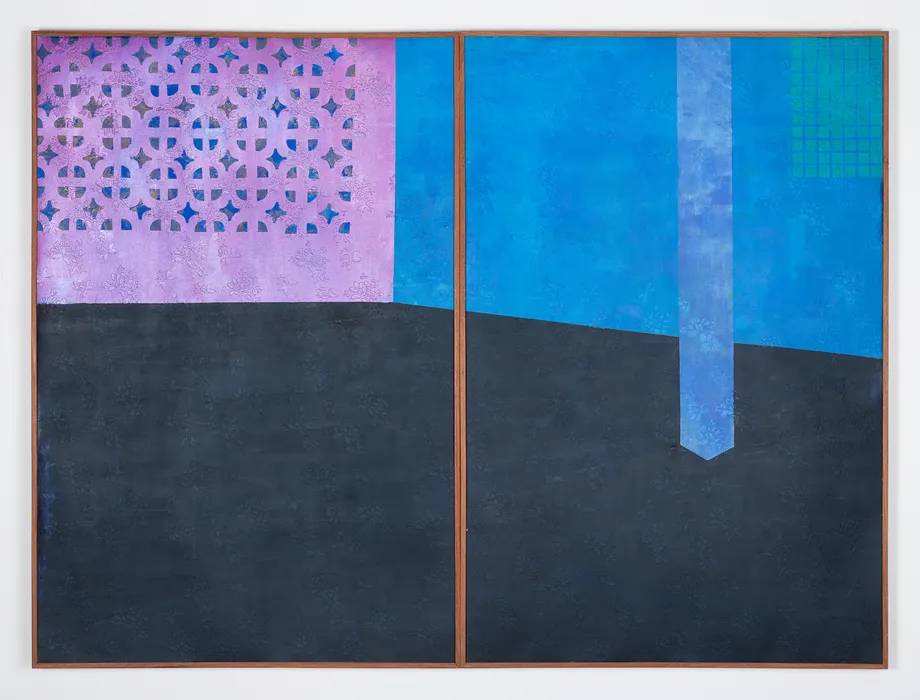
Naomi Lulendo (b. 1994, Paris; lives between Paris, Guadeloupe, and Dakar) works through assembly and disjunction, her architectural compositions resisting narrative coherence.
On the first floor, the artist presents two works structured as diptychs and polyptychs: Panorama I (2019) and Panorama IV (2026). The compositions draw on architectural space while resisting the coherence of linear perspective: planes flatten, shift, and overlap, producing environments that remain unresolved. These works invite close attention while allowing for misreading and the possibility of loss, echoing the logic of the puzzle, a recurring structure in her practice. In No Comment (2026), this refusal becomes explicit: the work withholds resolution, suspending meaning and resisting the impulse to complete the image or its narrative.
Together, these practices do not resolve into a unified reading, but instead sustain an open field of attention in which forms, bodies, and narratives remain in the process of becoming.


