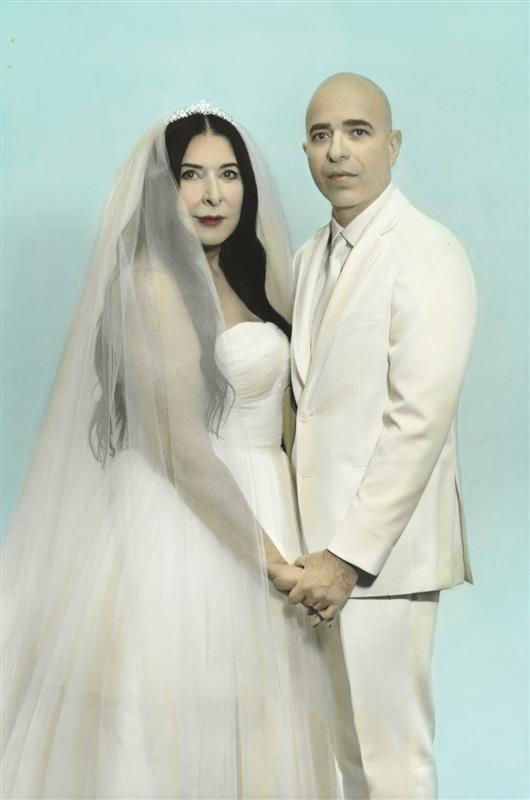
Mariane Ibrahim is pleased to present its first solo exhibition with Youssef Nabil, No One Knows but the Sky.
Cinema forms the stage upon which the photographic and video work of Youssef Nabil unfolds. Within it, the history of Egyptian cinema coexists with his childhood memories of Cairo, shaped by the film posters of a country that remains a major center of popular culture. Through its images, sounds, and stories, Egyptian cinema has shaped tastes, morals, and even language across the Arab world for decades. Through cinema, Nabil encountered art for the first time, and it remains the lens through which he continues to observe and register the many transformations of his native land.
More than a reference to his origins or to a particular region, Nabil’s work—and its centrality to the cinematic universe—appears fundamentally preoccupied with the act of remembering itself. It recalls a world that survives only through photographic record, through the freezing of an instant once fixed onto silver gelatin prints, and now captured predominantly in digital form. Time, a question central to the French film theorist André Bazin, lies at the core of this reflection: photography, Bazin writes, “embalms” time by halting it, while cinema goes further by “mummifying” change.
The work of Youssef Nabil, like art and cinema themselves, is intrinsically bound to the inevitable passing of the artist and each successive audience. Yet unlike those who confront this inescapable reality by measuring themselves against impossible ambitions of posterity, Nabil places it at the very center of his artistic practice: his work revolves around death in an unambiguous way.
Youssef Nabil contemplates the passage of time and, in his work, preserves traces of its transformations. Among these is an icon of Egyptian cinema: the belly dancer. Once a symbol of a modern and cosmopolitan nation, the figure of the belly dancer has, in recent decades, undergone a profound shift in popular perception. Amid a generalized rise in conservatism and increased state scrutiny, she has come to be seen as morally questionable, dangerous to embody, and confined to a private, regulated sphere. It is this symbolic disappearance that Nabil both bears witness to and seeks to counter, preserving the cinematic essence of this breathtaking sensuality, as performed by Salma Hayek and Tahar Rahim in I Saved My Belly Dancer (2015).
The journey of a lifetime is contemplated in The Beautiful Voyage (2021), a video in which Charlotte Rampling reflects on the fleeting nature of existence while the artist’s mother recites Constantine P. Cavafy’s poem Ithaca, words that evoke the epic departure that life itself represents. Finally, in The Room (2025), Nabil dares to cross the threshold of death, guided by artist Marina Abramović, who—like an angel—awakens him from the dream that is life and gently leads him toward a vision of paradise filled with music and playful lights.
The artworks presented in this exhibition—one of which gives the exhibition its title, and where the video The Room is shown for the first time—offer a glimpse into the last twenty years of the artist’s practice, where stylized videos move alongside hand-colored images. In these works, Nabil applies a meticulous process of painting directly onto the print, transforming each into a unique object, in the tradition of the Egyptian film posters of his youth, and echoing one of the oldest techniques of hand-colored photography still practiced today.
In the end, Nabil reminds us that while life passes with all its uncertainty, images continue to glow—like scenes that linger long after the film has ended.
