-
DOOR TO THE COSMOS
Exhibiting Artists:
Nick Cave, George Clinton, Michi Meko & Zohra Opoku
October 18 - December 13, 2025
-
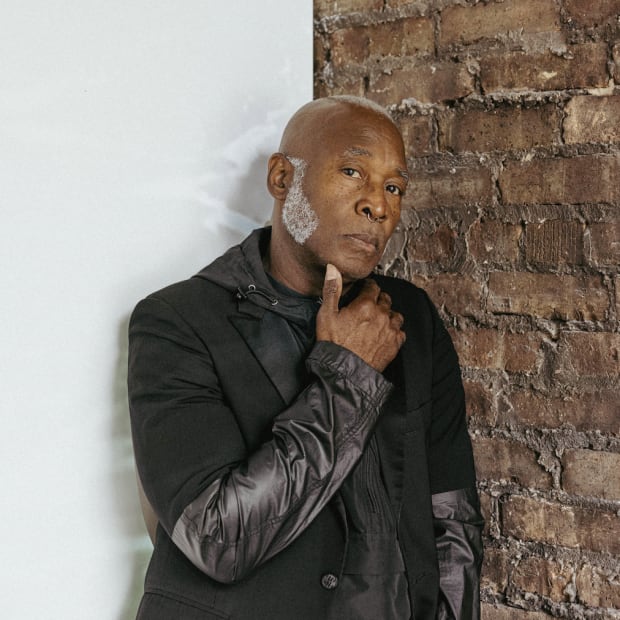
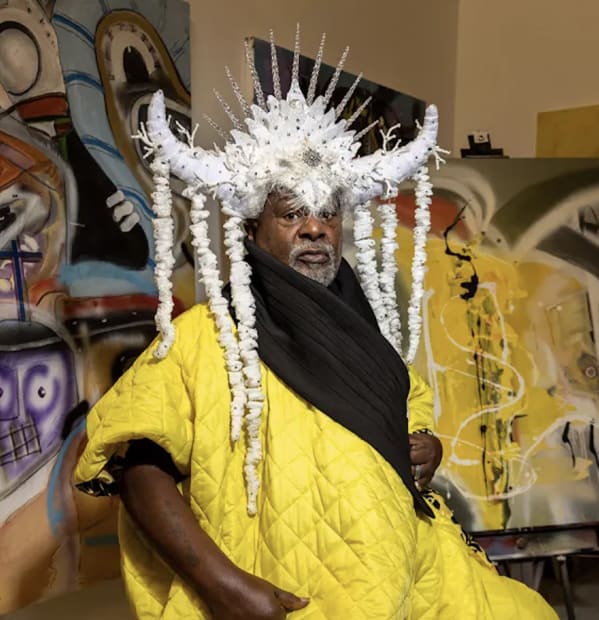
Mariane Ibrahim is pleased to present Door to the Cosmos, a group exhibition that traces constellations across past, present and future, bringing together works that traverse antiquity, speculative futures, and cosmic realms. The exhibition features works by Nick Cave, Michi Meko and Zohra Opoku, as well as the first European presentation of works by George Clinton, cultural icon, leader of the influential Parliament-Funkadelic collective, and sound architect of Afrofuturism, whose contributions to the arts span seven decades.
The universe is alive, and we are the evidence. Its pulsations manifest themselves both in the vibrations of the stars—which, translated into acoustic waves, resonate like the beating of a drum—and in the shock waves produced by the violence that permeates our societies. Between infinite wonder and the brutality of the immediate, a possibility opens, a bridge where imagination allows us to hold both extremes at once.
This exhibition approaches the cosmos from urgent realities. Nick Cave (b. 1959, Fulton, MO; lives and works in Chicago) opens the exhibition with Tondo (2023). In this work, the artist juxtaposes catastrophic weather patterns with brain scans of young Black men living with post-traumatic stress due to gun violence. The result is an abstract sculpture that invites us to lose ourselves in its vertiginous interior: deceptively light, resembling an undulating textile, yet constructed from rigid, immovable metal. This structure contains the tensions of the cosmos, a collapsing of time that encourages engagement between embodied experience and atmospheric phenomena.
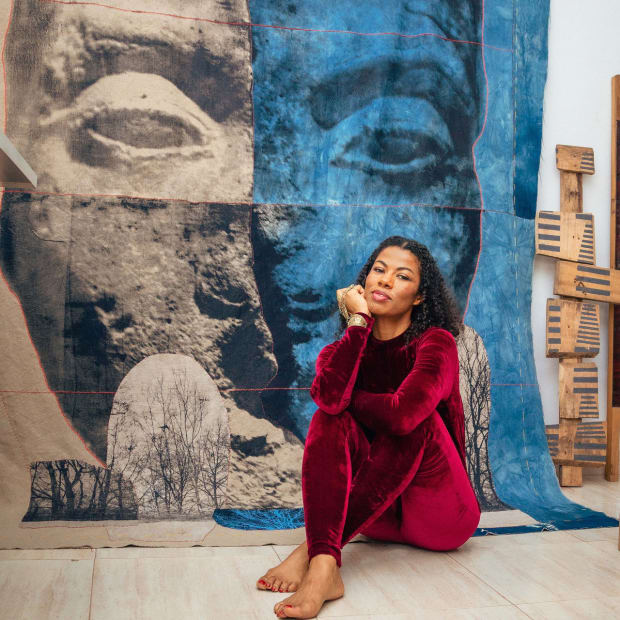
Zohra Opoku (b. 1976, Altdöbern, former GDR/ East Germany; lives and works in Accra) uses indigo, a traditional West African textile dye, to create a monumental work from her Myths of Eternal Life series. In Hail To You Great God (2022), the artist converses with the ancient Egyptian Book of the Dead, finding vital guidance within its pages. In the piece, her son confronts Anubis, God of the necropolis, who mediates between him and a female body: the fragmented, anonymous, and crisis-ridden maternal body that runs through the work, becoming a metaphor for a cosmic transition between life and the beyond.
Coinciding with his major exhibition at SCAD in Savannah, Georgia (on view through January 6, 2026), Michi Meko (b. 1974 in Florence, Alabama; lives and works in Atlanta) builds nocturnal landscapes born from the intersection of celestial cartography, the plastic gestures of street art, and the practice of fishing. In Crappie Painting: An Apocalypse. A Life for a Life. How to Kill a Fish (2022), the starry sky becomes a surface for exploration: the knot of the “backlash,” present in the works, is both a fishing term and a metaphor for the racist backlash that remains present in the US and particularly in the American South. “Crappie” in the title references both the freshwater fish and the brand of monofilament fishing line, bright green and looped into the painting multiple times to form star-like clusters. These glowing knots evoke a cosmic landscape, while also mirroring the spotted pattern of the crappie fish. Like Opoku, in Meko’s hands, the ordinary becomes celestial, reminding us that survival itself is a kind of sacred practice.
The exhibition culminates with an entire room dedicated to the pictorial and sculptural work of George Clinton, presented for the first time in Europe. A cultural icon, leader of the influential Parliament-Funkadelic music collective, and sound architect of Afrofuturism, Clinton has spent the last seven decades constructing entire universes in which spaceships, community, and funk intertwine as engines of radical imagination. His influence expands like a constellation that continues to shapecontemporary creation. In his works, Clinton invites us to take off together, to dance in zero gravity with his Atomic Dogs, to celebrate life in all its forms: a cosmic journey where joy is the force that holds the universe together.
-
-
-
 Nick Cave, Tondo, 2023
 -
George Clinton and Jona Cerwinske, Dogstar Bright, 2023
-
George Clinton, DJ Pooper Scooper, 2023
-
George Clinton, Ma’me’s best friend, 2023
-
George Clinton, Pawz n’ FX, 12/13/21, 2021
-
George Clinton, Ruff 2, 2023
-
George Clinton, Seeing is retrieving , 2021-07-20, 2020
-
George Clinton, The Shiny One, 2024
-
George Clinton, Cosmo, 2023
-
George Clinton, Canine Star Cluster, 2023
-
George Clinton, DidgeriDog, 2023
-
George Clinton, U Da Dog, 2023
-
George Clinton, Data Dog, 2023
-
George Clinton and Overton Loyd, Mothership, 2025
-
Michi Meko, Crappie Painting: Render An Apocalypse. A Life for a Life. How To Kill a Fish, 2022
-
Zohra Opoku, 'I am one who goes forth prospering, whose name is not known. I am yesterday. The one who sees millions of years is my name.' [Extract from Chapter 42: Spell for warding off slaughter in Herakleopolis/ An Ancient Egyptian Book of the Dead/ The Papyrus of , 2023
-
Zohra Opoku, ‘Hail to you great god, lord of the Two Truths. I have arrived before you, my lord. One brings me to you so that I may see your beauty. I know you. I know your name. I know the names of the forty-two gods who exist with you, in this broad Hall of the Two , 2022
-
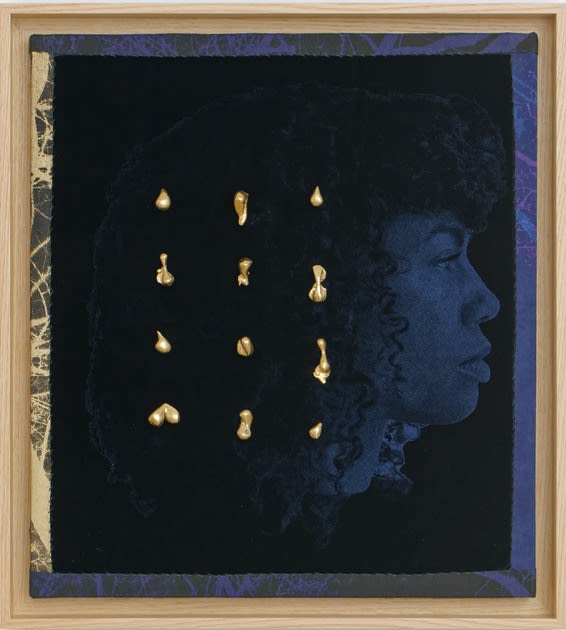
Zohra Opoku, ‘I have made divine offerings to the gods, invocation offerings to the akhs. Save me, then; protect me, then.’ [Extract from chapter 125: Arrival at the broad hall of the two truths/ An Ancient Egyptian Book of the Dead/ The Papyrus of Sobekmose], 2024
-
-
-
-
-



![Zohra Opoku, ‘I have made divine offerings to the gods, invocation offerings to the akhs. Save me, then; protect me, then.’ [Extract from chapter 125: Arrival at the broad hall of the two truths/ An Ancient Egyptian Book of the Dead/ The Papyrus of Sobekmose], 2024](https://artlogic-res.cloudinary.com/w_740,c_limit,f_auto,fl_lossy,q_auto/artlogicstorage/marianeibrahim/images/view/1d3577e6b967b4c78c3ab4eacd183693j/marianeibrahimgallery-zohra-opoku-i-have-made-divine-offerings-to-the-gods-invocation-offerings-to-the-akhs.-save-me-then-protect-me-then.-extract-from-chapter-125-arrival-at-th.jpg)